- No products in the cart.

Pricing handmade products is where most craft businesses quietly fail. Not dramatically. There is no single bad month. The maker just works harder every year, sells more every year, and somehow never has any money.
The usual diagnosis is “undercharging out of low confidence”. Sometimes that is true. Far more often it is arithmetic: the maker is genuinely unaware of what their product costs to produce, because several real costs never appear in the sum.
This guide fixes the arithmetic. Seven formulas, worked through with actual numbers, plus the costs crafters forget and the specific points at which prices should change.
What’s in this guide
- Why pricing handmade products goes wrong
- The costs crafters forget to count
- 7 formulas for pricing handmade products
- A full worked example, start to finish
- Pricing for markets, online and wholesale
- When and how to raise your prices
- Handling price objections
- Tracking your real margins
- Seasonal pricing and the festive trap
- Pricing handmade products FAQ
Why pricing handmade products goes wrong
Three mistakes account for nearly all of it.
Pricing against hobbyists
At any South African craft market, some sellers are running businesses and some are funding a hobby. The hobbyist genuinely does not need to cover their time: the making is the reward. If you price against them, you are competing with someone whose costs are structurally lower than yours can ever be.
Forgetting that your time is a cost
“I enjoyed making it” is true and irrelevant to the accounting. If you spent two hours on a piece, those two hours were unavailable for anything else. Unpaid labour is the most common hidden subsidy in craft businesses.
Pricing from the customer’s wallet instead of your costs
Deciding “R150 feels like what someone would pay” skips the entire question of whether R150 covers what the item cost you. Start from cost, then sanity-check against the market: never the reverse.
The test
If your business suddenly received 100 orders, would that be wonderful or terrifying? If it is terrifying, your prices are too low. Correctly priced work scales; underpriced work collapses under its own success.

The costs crafters forget to count
Before any formula works, the inputs have to be honest. Most makers count materials and stop. A genuine unit cost includes:
- Materials, including the offcuts and waste, not just what ended up in the finished piece
- Consumables: ink, thread, glue, tape, packaging, the printed care card
- Your labour, at a real hourly rate
- Equipment wear: machines have a finite life and are being used up
- Failures: the pieces that go wrong are paid for by the pieces that sell
- Overheads: electricity, internet, software, market stall fees, insurance
- Transaction fees: payment gateways typically take a percentage of every sale
- Shipping, if you absorb any part of it
- Admin time: messages, quotes, proofs, bookkeeping
That last one is brutal for personalised work. A customised order might involve fifteen minutes of back-and-forth about a photo before any making starts. Personalisation is a premium service and should carry a premium price. If your personalised work is produced by heat press, our guide to sublimation printing covers the production side of the same equation.
Setting your hourly rate
Pick a number you would accept for skilled work from an employer, then remember you are also carrying the risk, the admin and the equipment. A common starting point is what you would earn hourly in a comparable job. If that feels too high for your product to bear, that is real information about the product, not a reason to work for less.

7 formulas for pricing handmade products
No single formula is correct for everyone. Run two or three and compare: where they disagree is usually where your business model needs a decision.
1. The beginner formula
(Materials + Labour) × 2 = Retail
Doubling covers overheads, failures and a modest profit. Materials R40, labour 1 hour at R120 = R160, retail R320.
Simple, fast, and better than guessing. Its weakness: the doubling is a blunt instrument that ignores whether your actual overheads are high or low.
2. The wholesale-ready formula
(Materials + Labour + Overheads) × 2 = Wholesale × 2 = Retail
The essential formula if you ever want a shop to stock you. Costs R160 plus R30 overheads = R190. Wholesale R380. Retail R760.
That retail number often shocks makers. But a retailer needs roughly a 50% margin to justify shelf space, and if your direct price is already at wholesale level you can never sell through shops without undercutting yourself.
3. The hourly-rate formula
Materials + (Hours × Rate) + Overhead allocation + Profit margin
The most accurate for time-heavy work. Materials R40, 1.5 hours at R150 = R225, overheads R30, plus 25% profit = R369.
Best for one-off commissions and intricate pieces where time genuinely varies per item.
4. Keystone pricing
Total cost × 2
Retail’s oldest rule of thumb. Fast for a market stall where you must price fifty items quickly. Too crude for anything complex, but a reasonable floor: if a formula suggests less than keystone, check your figures.
5. Target-margin pricing
Price = Total cost ÷ (1 − desired margin)
Cost R200 with a 60% target margin: R200 ÷ 0.4 = R500.
Note the difference between margin and markup: a 60% margin is not a 60% markup. Confusing the two is a classic way to lose money while believing you are profitable.
6. Value-based pricing
What is this worth to the buyer?
Cost-based formulas ignore meaning. A personalised keepsake for a milestone birthday is worth far more to that buyer than the sum of its materials. Sentimental and personalised work carries genuine value-based headroom, which is why personalised gifts sustain higher prices than equivalent unbranded items.
Use it as a ceiling check, never as your only method: value-based pricing without a cost floor is just guessing with extra confidence.
7. Tiered pricing
Good / better / best
Rather than one price, offer three levels: standard, personalised, and premium with gift packaging. Most buyers choose the middle option, which raises your average order value without persuading anyone of anything.
It also reframes the conversation from “is this too expensive?” to “which one do I want?” A much better question to have your customer asking.
A full worked example, start to finish
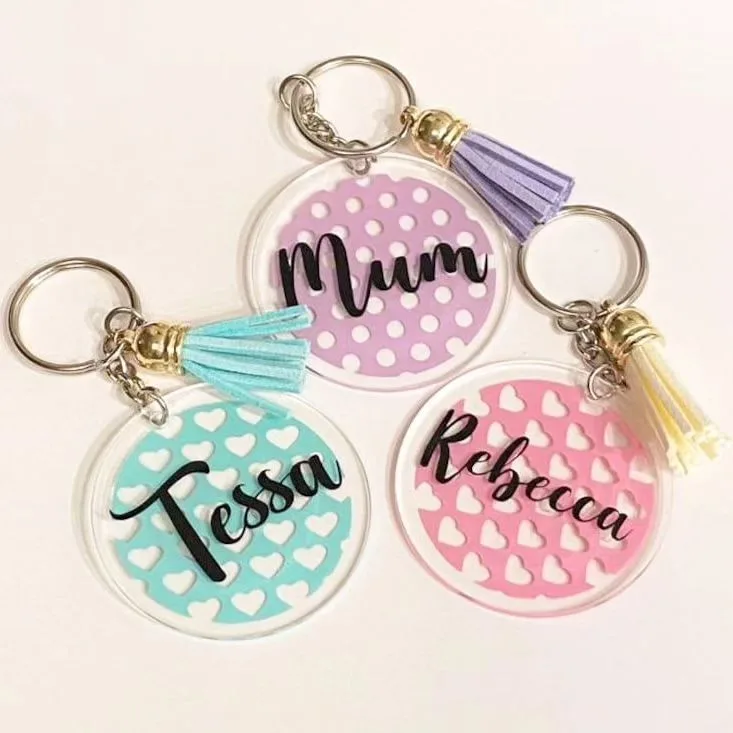
Formulas make more sense against a real item. Take a personalised photo keyring, made to order.
Step 1: count the materials honestly
- Blank keyring: R18
- Transfer paper and ink for one press: R4
- Packaging (bag, card, sticker): R6
- Waste allowance at 10%: R3
Materials total: R31
Step 2: count the time honestly
- Customer messages and confirming the photo: 10 minutes
- Preparing and sizing the artwork: 8 minutes
- Printing and pressing: 7 minutes
- Packing and labelling: 5 minutes
That is 30 minutes. At an hourly rate of R150, labour is R75.
Note how much of that half hour is not making. Admin is over half the time on a small personalised item, which is exactly why cheap personalised work is so punishing.
Step 3: add overheads
Suppose your monthly overheads (electricity, internet, software, equipment set-aside) come to R2 000 and you make roughly 100 items a month. That is R20 per item.
Step 4: run the formulas
| Formula | Calculation | Price |
|---|---|---|
| Beginner | (31 + 75) × 2 | R212 |
| Hourly-rate + 25% profit | (31 + 75 + 20) × 1.25 | R158 |
| Keystone | (31 + 75 + 20) × 2 | R252 |
| Target margin (60%) | 126 ÷ 0.4 | R315 |
| Wholesale-ready retail | 126 × 2 × 2 | R504 |
Step 5: choose, and know why
The spread here is R158 to R504, and every one of those numbers is defensible. The right answer depends on your model.
Selling direct at a market and never wholesaling? Somewhere around R210 to R250 works. Planning to place stock in gift shops? You need the R500 structure from the beginning, or you can never wholesale without cutting your own throat.
What is not defensible is R89, which is roughly what this keyring would sell for at a market where everyone has priced against each other and nobody has counted their time.
Pricing for markets, online and wholesale
The same item should not carry the same price everywhere, because your costs differ per channel.
| Channel | Extra costs | Pricing approach |
|---|---|---|
| Craft market | Stall fee, transport, a full day of your time | Full retail. Divide the stall fee across realistic sales and add it in. |
| Your own website | Gateway fees, packaging, shipping, photography | Full retail. Best margin, but you carry the marketing. |
| Marketplace platform | Listing and commission fees, often 5–10% | Retail plus the commission, or your margin quietly disappears. |
| Wholesale to a shop | Volume, but no marketing cost | Roughly half your retail. Only viable if retail was set correctly. |
| Corporate or bulk orders | Higher volume, longer payment terms | Modest volume discount only. Bulk does not remove your labour. |
Keep your retail price consistent across channels where customers can see both. Undercutting your own stockists is the fastest way to lose them.
When and how to raise your prices
Four signals that pricing handmade products at your current level is no longer viable:
- You are consistently busy but not accumulating money
- Material costs have risen and you have absorbed them silently
- Nobody ever hesitates at your price: a total absence of resistance means you are under market
- You feel resentment when an order arrives
That last one is a genuinely reliable indicator. Resentment is usually accurate accounting arriving as an emotion.
How to actually do it
Raise prices on new products first, where there is no comparison. Increase in meaningful steps rather than trivial ones: moving R180 to R185 is not worth the effort. Give existing wholesale accounts notice. And do not explain or apologise on your website; a price is a statement, not a negotiation.
Most makers who raise prices report the same two things afterwards: they lost a small number of customers who were never profitable anyway, and they wish they had done it a year earlier.
Handling price objections without discounting
Once you price properly, someone will eventually tell you it is expensive. This is normal and is not evidence that you are wrong.
“That is expensive”
Often not even an objection, just thinking out loud. The worst response is to immediately discount, which teaches the customer that your first price was not serious. A calm explanation of what goes into the piece does more than a 15% reduction.
“I can get it cheaper elsewhere”
Frequently true, and fine. Mass-produced goods will always undercut handmade work. You are not competing on price and cannot win that fight. What you offer is personalisation, small-batch quality and a person who answers messages.
“Can you do a discount for bulk?”
A modest discount is reasonable for genuinely large orders, because your admin per unit drops. But twenty personalised items are twenty separate setups. Volume reduces admin overhead; it does not reduce making time. Discount accordingly and no further. The same logic applies to corporate and bulk gift orders, where buyers often expect a discount that the production reality does not support.
“Can you do it cheaper without the packaging?”
Be careful here. Stripping components to hit a price point erodes the thing that justified your price. Better to offer a genuinely simpler product at a lower tier than to quietly degrade your standard one.
Worth remembering
You are not obliged to win every customer. A maker who converts every enquiry is almost certainly priced too low. Losing some price-sensitive enquiries is a sign the pricing is working, not failing.
Track it, or you are still guessing
Pricing handmade products is not a one-off exercise. Material costs move, your speed improves, and your product mix changes.
A simple spreadsheet with one row per product covers it: materials, minutes, overhead share, current price, and resulting margin. Update it whenever a supplier price changes.
Two numbers are worth watching monthly. First, your average margin across everything sold, which tells you whether your mix is drifting toward low-value work. Second, your effective hourly rate: total profit divided by total hours actually worked. That second number is the honest one, and it is often sobering the first time a maker calculates it.
If your effective hourly rate is below what you would earn in a job, the business is currently a subsidised hobby. That may be a perfectly acceptable choice, but it should be a choice rather than a surprise.
Seasonal pricing and the festive trap
South African craft businesses earn a disproportionate share of their income between October and December. That concentration creates two specific pricing risks.
Do not discount into your busiest season
Black Friday pressure pushes many makers into discounts precisely when demand is highest and their capacity is most constrained. Discounting scarce capacity is the worst possible trade: you sell out either way, but at a lower margin, and you exhaust yourself doing it.
If you want a festive offer, make it something that raises order value rather than lowering price. Free gift wrapping above a threshold, or a third item at a reduced rate, both protect your margin while still feeling generous.
Price the deadline, not just the product
Rush orders in December carry a real cost: they displace planned work, they compress your press schedule, and they raise the chance of an expensive mistake. A clearly published rush fee is normal, professional practice and filters out the requests that are not worth the disruption.
Use the quiet months to fix your numbers
January through March is when most makers have time and no orders. That is the right window for pricing handmade products properly: recost every line, update the spreadsheet, and put new prices in place well before the next busy season rather than in the middle of it.
Raising prices in November, under pressure, with a backlog of orders, is how mistakes happen. Doing it in February, calmly, is how a craft business becomes sustainable.
Pricing handmade products: FAQ
How much should I charge per hour as a crafter?
Start from what you would earn hourly doing comparable skilled work for an employer, then remember you also carry the equipment, the risk and the admin. Many South African makers settle somewhere between R120 and R250 an hour depending on skill level and product. If your product cannot bear your rate, that is information about the product.
Should I charge more for personalised items?
Yes, and most makers do not charge nearly enough. Personalisation adds proof cycles, customer messages, artwork setup and a much higher risk of remakes. It is a premium service and pricing handmade products without accounting for it is a common way to lose money on your most popular line.
How do I price for a craft market?
Full retail, with the stall fee spread across the number of sales you realistically expect rather than the number you hope for. If the stall costs R500 and you typically sell thirty items, that is around R17 per item that must be in your price.
What margin should a handmade business aim for?
A 50 to 60% gross margin on direct sales is a reasonable target for small-batch handmade work. Below 40% there is usually not enough room to absorb a bad month, a price increase from a supplier, or a batch that goes wrong.
Is it bad to be the most expensive seller at a market?
Not inherently. Being the cheapest is a far riskier position, because it attracts customers with no loyalty and leaves nothing to cut when costs rise. Price for the customer who wants the good version, not the one hunting a bargain.
How often should I review my prices?
Twice a year as a habit, and immediately whenever a major material cost changes. Absorbing supplier increases silently is the slowest and most common way a profitable craft business becomes an unprofitable one.
Where to go next
If you are formalising the business side, the Small Enterprise Development Agency offers free support to South African small businesses, and SARS publishes the current turnover threshold at which VAT registration becomes compulsory.
And if you are still choosing what to make, our crafting supplies and customisable items ranges are a reasonable place to see what personalised products look like at retail.
Make it personal
Every item in our range can be customised with your own photo, name or message, printed and finished in-house and delivered anywhere in South Africa.